Showing posts with label Postpartum Fitness. Show all posts

Wednesday, July 30, 2014

Postpartum Exercise Facts & Stats

You're at least 6 weeks postpartum, and you're already thinking about wanting to get out of the house and get active. Struggling with what to do? Here are some great facts and stats that will show you why you should sign up for an Oh Baby! Fitness class!

POSTPARTUM EXERCISE FACTS & STATS

- Returning to exercise is linked to a decrease in postpartum depression.
- Women who took structured group exercise programs after delivery showed more success at losing body fat and keeping it off 1 year postpartum than those who didn't exercise.
- Women who brought their babies and exercised in a group with others in an Oh Baby! Fitness class had less guilt about leaving their baby with a caregiver, were able to stop and feed the baby any time, and were able to build a community.

SAFE EXERCISES TO DO DURING FIRST 6 WEEKS POST DELIVERY

- Walking - ONLY if it makes you feel good!
- Kegel exercises (pull pelvic floor muscles up and in, similar to how you would stop the flow of urine).
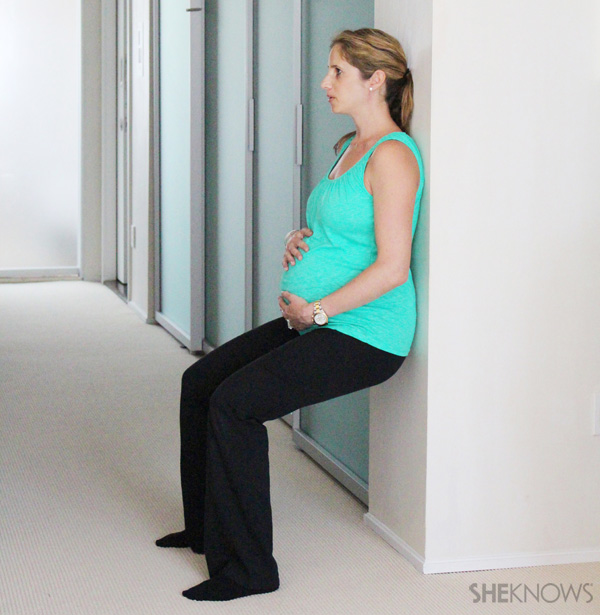
- Abdominal hollowing (pull belly button toward spine during exhale and imagine pulling bottom ribs toward each other, and hold for 3-5 seconds, no need to do it in a wall squat! Do in a sitting position).

- Chest stretches (bring hands behind back, interlace fingers, open chest)


POSTPARTUM DEPRESSION

There are 3 types of postpartum emotional and mental woes:

1- Baby Blues- women feel weepy, overwhelmed, and irritable. It can last up to 10 days, and 80% of women struggle with this post baby. Extra sleep and some time away from baby helps lessen the symptoms.
2- Postpartum Depression - women feel sad, anxious, have changes in appetite, insomnia, and/or guilt. Can last 2 or more weeks, and at least 15% of women struggle with PPD. With counseling and/or medication (and exercise!), women can begin to see a decrease in symptoms.
3- Postpartum Psychosis - women feel manic, paranoid, severe depression, violent thoughts and/or tendencies. Only 5% women struggle with PPP, and they are able to find peace and comfort through inpatient psychiatric treatment.

Read more at Postpartum International at www.postpartum.net or call (800) 994-4PPD.

Wednesday, July 23, 2014

Prenatal Exercise Facts & Stats

For those of you who are deliberating over whether you should start exercising or continue exercising once you're pregnant, these facts and stats are just for YOU! 

These stats and facts are based upon research done by Dr. James Clapp, who was a professor emeritus of reproductive biology at Case Western Reserve University and a research professor of obstetrics and gynecology at the University of Vermont College of Medicine.

PRENATAL EXERCISE FACTS


-Pregnant women who exercise experience shorter, easier, and faster labors (an average of 2 hours less!).
- 24% of exercising pregnant women had fewer cesareans and fewer complications than women who did not exercise.

Pregnant women who exercised also experienced:

- 35% decreased need for pain relief
- 75% less maternal exhaustion
- 50% decreased need to be induced
- 50% lowered need to have Pitocin to quicken labor
- 50% decreased medical intervention because of abnormal fetal heart rate
- 50% less episiotomies (ALL THOSE KEGELS!)
- 75% decrease in the need for forceps or c-section

***Women who exercise regularly during pregnancy maintain positive attitudes about themselves, their pregnancy, and their upcoming labor and delivery.

***Exercise decreases the occurrence and width of Diastasis Recti (abdominal separation).


Want to learn more about prenatal exercise? Sign up for an Oh Baby! Prenatal Fitness class at 
ohbabyfitness.com!


Tuesday, June 24, 2014

How Coordinated Pushing is Important During Delivery

There is plenty of research and studies done to show the importance of core strength and breathing techniques during labor and contractions. However, there is not much education for pregnant women on what muscles to use and what muscles to relax when pushing their baby out.


It's key to think about what actually happens during the pushing phase of delivery. When it's time to bear down and start pushing, what tends to happen is that the mom will tighten all of her muscles: abdominals, buttocks, legs, and pelvic floor. Although this is natural (being in severe pain and fatigue obviously makes it hard to relax and let your body do its thing!), what happens is while the mother pushes her baby down the birthing canal, she is also moving her baby's head up against her tight and contracted muscles in her pelvic floor. 

Learning and practicing coordinated pushing can help prevent this (along with other things, like tearing) and encourage an easier and faster delivery. It can be hard to learn at first, but once you get the hang of it, it's so important to practice and use during delivery!

Performing belly breathing is a great way to practice contracting and strengthening the abdominals. Kegel exercises are just as important and great for strengthening and relaxing the pelvic floor muscles. The trick to coordinated pushing is including both of these exercises in a combined manner. As the saying goes, "push with your gut, not with your butt!". Practicing by contracting the abdominals and relaxing the pelvic floor is exactly what should also be done during the pushing phase of delivery.

Check out this video from the Oh Baby! Fitness blog on combining Kegels and Belly Breathing to perform Coordinated Pushing.


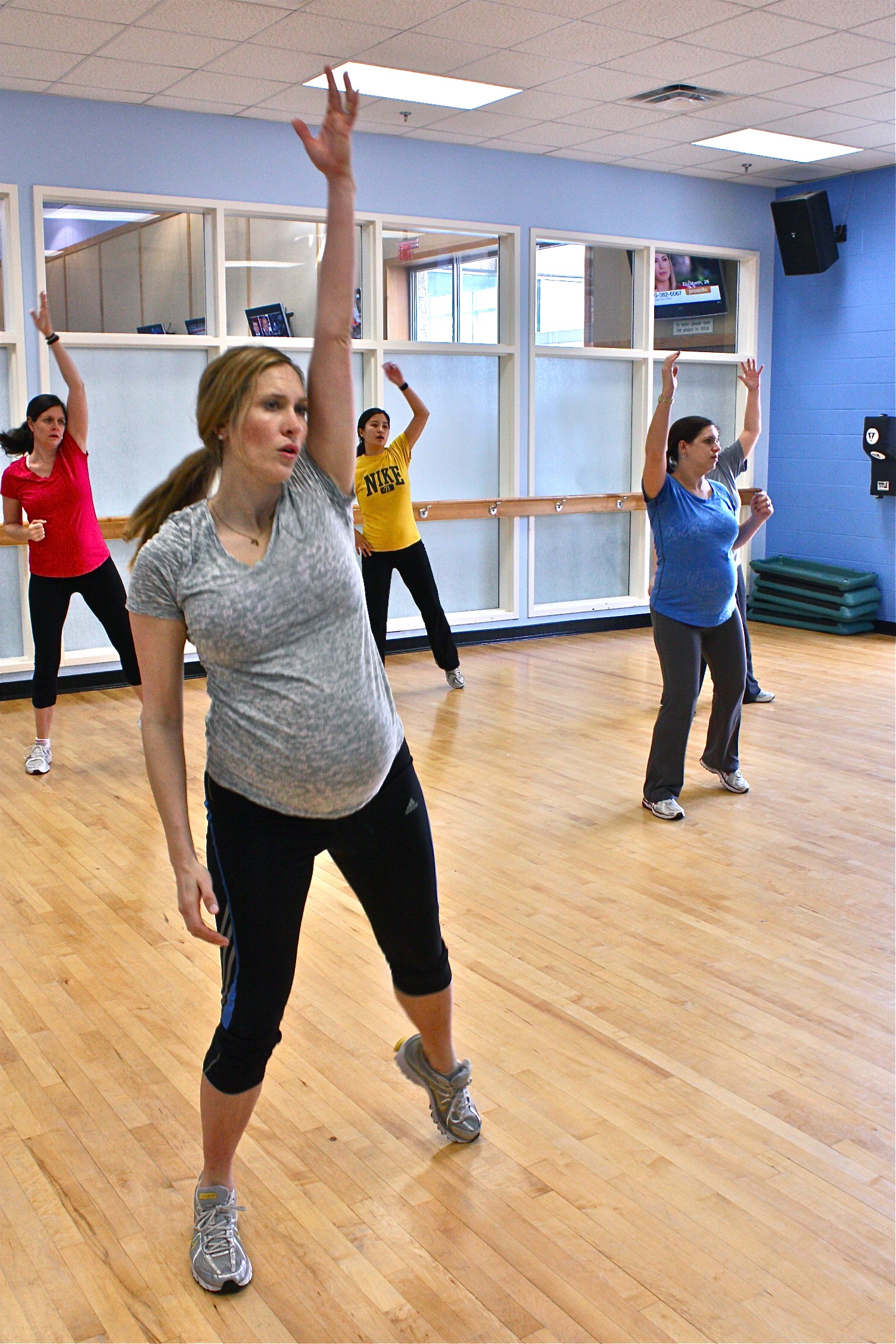
To strengthen your core, pelvic floor, and learn more about coordinated pushing, sign up online today for a Prenatal Oh Baby! Fitness class taught in Berry Hill in Nashville. More than just prenatal yoga, we focus on cardio, upper and lower body strengthening, core and pelvic floor health and strength, and some yoga stretches!

Click HERE to sign up!


Friday, June 13, 2014

Top 8 Excuses That Women Use to NOT Exercise During Pregnancy

So you're pregnant. And you know you need to either get active or stay active (depending on your fitness level). But you also have these fears, doubts, and concerns about what's too much, what's not enough, and if it is even safe at all. 

As Kathleen Donahoe (COO of Oh Baby! Fitness) puts it:
"ACOG (the American Congress of Obstetrics and Gynecology) recommends pregnant women work out at a moderate level for at least 30 minutes on most, if not all days of the week.  Basically, they want you working out at a moderate (note, not gentle) level every single day. Pregnancy is not the time to curl up and rest, it’s the time to prepare for the most strenuous jobs on the planet- motherhood! ".

I've been doing some research on what seems to be the biggest reasons why women are either too afraid of working out while pregnant, or are just trying to justify their way out of staying active throughout their pregnancy. And here is what I've discovered.

Top 8 Excuses Why Women Will NOT Exercise During Pregnancy


1. "I am not in shape!"
Just because you are not "in shape" when you get pregnant doesn't mean it's not a good time to start exercising! Pulling from one of the Core Beliefs held by myself and Oh Baby! Fitness:

Pre- and postnatal EXERCISE IS IMPORTANTWe believe exercise during pregnancy creates easier labors, healthier babies, and happier new moms. We listen to the latest studies about perinatal exercise, share them with our clients and instructors, and build our programming based on their recommendations. And we encourage women to get in the best shape of their lives during pregnancy.

Prenatal and postpartum exercise is key to having a healthy pregnancy, delivery, and postpartum recovery! Not to mention, a healthier mom and baby!


2. Wrong Trimester
Check this out: as long as your doctor KNOWS and APPROVES of you getting active, there is NO WRONG TRIMESTER to start exercising! Exercise provides multiple benefits throughout each trimester and can help with prenatal aches and pains. Studies have shown that women who exercise up until their delivery date are:
-       Less likely to have premature labor
-       Less likely to have babies with low birth weight
-       Less likely to have a c-section
-       Less likely to request/use pain management during labor
-       More likely to have shorter, quicker labors
-       More likely to gain less weight during pregnancy

(http://blog.ohbabyfitness.com/category/pregnancy-exercise-tips/page/3/#sthash.RzdavdEk.dpuf)

Note: if you develop a condition that causes you to be high risk, it is important to listen to your doctor and your body before exercising.

3. You've NEVER exercised a day in your life
You have never used a dumbbell. Exercise bands look like they could snap in half. And you've never done any kind of pushup ever. You are the PERFECT candidate to start exercising! Especially with other pregnant or new moms! It's a gentle environment filled with support, compassion, and a Perinatal Fitness Expert who is ready to guide you through each and every question you may have!

4. Feeling under the weather
If you're feeling nauseated in your first trimester, limited in your second, or exhausted in your third, going for a walk (not doing a massive workout) can at least help makes those feelings subside. Better yet, getting out and being a little active with other expecting or new moms can lighten the load of all those feelings, and others such as depression, anxiety, and loneliness. 


5. Back, hip, and other pains and aches
Your hips are aching due to round ligament pain or your low back hurts because of sciatica. Getting active and moving your body gets the blood flowing, loosens up muscles, and can help relieve several discomforts: swelling of feet and hands, varicose veins, pelvic pain, SI joint pain, spinning breech babies to head down position, carpel tunnel, nausea, insomnia, control/manage gestational diabetes, and control overall weight gain.


6. "What if I need to pee 10 times during a prenatal fitness class?"
It’s okay to go pee, and barf, and eat, and fart, and cry. A pregnancy exercise class is sometimes the ONLY place no one will look at you funny for the behaviors that pregnancy brings on. So don’t worry if you suddenly are the girl that accidentally lets one fly, or that breaks down in tears. We understand, and I've seen it all! So do your thing, and we'll do ours!

7. "Do I need a gym membership to come to a class?"
Nope! You just get to walk into class, sign in, sign a waiver, and get your sweat on!

8. "I'm afraid that I will have a miscarriage"
Many women fear that exercising, falling, lifting heavy objects or the like can trigger a miscarriage, but the chances of that happening are slim. “Unless you are a smoker, illicit-drug user or heavy drinker, there’s very little you can do to cause a miscarriage,” notes says Henry Lerner, M.D., an OB-GYN at Newton-Wellesley Hospital in Newton, Mass., and an assistant clinical professor in obstetrics and gynecology at Harvard Medical School. 


What other fears, concerns, or excuses do you find yourself having that keeps you from being active during your pregnancy?

Friday, May 2, 2014

New Oh Baby! Fitness Prenatal Classes!

Wow, it's been a long time. Sorry for being so busy!

I'm very excited to announce that I will now be teaching Oh Baby! Fitness Prenatal Toning, Fitness, & Yoga Combo classes at Results Fitness on Music Row! Starting May 27th-July 24th (no class July 1st or 3rd), so sign up now and get your Oh Baby! Fitness ON!

From the website:

At Oh Baby! Fitness, our focus is to give new and expectant moms a place to find support, make friends, get fit and bond with their babies. We offer the widest variety of fitness classes designed to take moms from pregnancy through birth, and then into the toddler years with their child. Our programs allow Mom to get out of the house, get her body back in shape and spend time with baby.
All of our instructors are specially trained in a nationally recognized pre/postnatal fitness certification, so they really know what they’re doing. Our instructors will help you make the modifications you need to build strength and lose weight. We've also partnered with area hospitals because they offer a safe environment for our classes and because doctors need to know what kind of exercise their pregnant and postpartum patients are participating in. 

If you live in or close to the Nashville area, go to ohbabyfitness.com to check out the classes and sign up. Classes are small and will fill up soon, so get a move on!


Tuesday, April 8, 2014

Top 5 Exercises to Prepare for Labor

Although prenatal yoga and stretching is great and important for women who are pregnant, but so are strong muscles! Labor and delivery is THE toughest and biggest marathon a woman's body will ever go through, and will be pushed beyond its limits. This marathon requires some muscular strength and endurance!

This is true for both vaginal deliveries and c-section deliveries. Having a strong lower body will help a mother recovering from a c-section by allowing her to use her strong legs for simple things like getting up and down, using the restroom, and walking around. With stronger legs, the abdominals can relax and recover more efficiently.

Try doing these 5 exercises for the rest of your pregnancy and you will definitely notice a difference in your labor, delivery, and postpartum recovery!

1.  Squats

Squats, lunges, and wall sits encourage the baby to face backward in the birth canal, which helps avoid "sunnyside up" babies who are facing foward, which increases painful back labor. They also increase leg and glute strength which is helpful during labor and pushing.  If your glutes are strengthened, that also means your pelvic floor is strengthened and the lower back is more naturally aligned.


Feet a little wider than hip width apart, and instead of arms out, I would say hands on hips. Pull the belly button in and lower your body to just above a 90 degree angle in the knees.
 Do 3 sets of 10 repetitions.

2.  Lunges


Notice how big of a forward step you need to take. Keeping you feet hip width apart, take a big step forward with a chair next to you giving you support and balance. Keeping your weight in the heel of your front foot, dip the back knee straight down and then lift back up. Stay in this position, and lower and lift until you complete 10 repetitions. Then switch sides. Do 3 sets of 10 reps on each side.

3.  Wall Sit


Wall sits can be done with or without an exercise ball. If you use an exercise ball, you will find that it gives a little back massage and makes it easier to get in and out of the squat. Choose what you like best and stick with it.

Keep feet hip width apart and knees in line with hips as you lower down to a 90 degree angle in your hips and knees. Keep your weight in your heels and toes relaxed. Sit here for up to 2 minutes. This is also a great time to do belly breathing, giving you a chance to focus on your breathing and pushing through the squat discomfort, similar to a contraction.

Feel free to do up to 3 wall sits and holding it there for 30 seconds to 2 minutes.

4.  Seated Pelvic Tilts

Pelvic tilts help decrease back pain and it also helps get the baby to be head down in the birthing position. They are also helpful during labor as they help women breathe through contractions. 


Sitting on a ball, chair, or couch and with correct posture, pull your tailbone under and contract your abdominals, tilting your pelvis forward. Your glutes will automatically contract; however, try to make your abdominals do more of the work. Release and go back to your regular posture. Do 3 sets of 10 repetitions.

5.  Plank

Plank is an exercise that utilizes the transverse and rectus abdominis muscles. This is a very efficient exercise and a very important one. Having strong transverse abdominals will help during the pushing stage of labor and will also help recovery from diastasis recti (the central splitting of the rectus abdominis).

Forearms and Toes


Forearms and Knees


For a more advanced plank, do it on your toes. But for beginners or for those who feel unstable on their toes, go on your knees. Just make sure elbows are directly under shoulders, hips are in line with your torso, and your abdominals are pulled in with your chest engaged.
Do 1-3 planks holding each for 30 seconds to up to 2 minutes.


Doing these 5 exercises 2-3 times per week will be extremely helpful during pregnancy, labor, delivery, and postpartum recovery. They will also help with any prenatal ailments (back pain, sciatic pain, leg pain, etc.).


Friday, March 7, 2014

Hate Squats? Try These 3 Leg Exercises

Some people do not like to do any type of squat due to bad knees, bad back, bad hips, or because they just hate to do squats.

Although squats can be inappropriate for some people, it's also important to keep leg muscles strong, especially in the hips and around the knees. Here are 3 appropriate and safe leg exercises to not only keep those lower body muscles strong, but to also decrease joint paint and increase joint stability.

Bridges


Lying on your back, feet and knees hip width apart, brace your abdominals and lift your hips up to the ceiling, squeezing the glutes at the same time while pushing through your heels.

Bump it up!
To make it more challenging, touch your knees together when your hips are at the top, then widen the knees again as you lower your hips back down.


Knee to Toe

Knee to knee

Toe to toe


Obviously just starting out with no band, lying on one side, bend the knees. While keeping both legs bent, lift the top leg and rotate the hip forward, bringing the knees together. Then rotate the hips back and bring the toes together. This works the entire range of motion of the hip, making it strong and stable. Be sure not to rotate the back as you bring the hips forward and back. And keep the core tight!

Bump it up!

Feel free to add a band as shown to increase the difficulty!


Table Top Hip Extension

Another way to strengthen the glutes, low back, hips, and hamstrings is this hip extension exercise in the table top position (all 4's).


On all 4's, make sure shoulders are above wrists and hips are above knees. Keeping the back completely straight and core tight, straighten a leg behind and lift up to hip height. Bring the leg back in and repeat with the same leg. Then switch sides. Make sure the chest is engaged and elbows are slightly bent.

Bump it up!

Keeping the working leg extended, lift it to hip height, then tap the toe on the floor, and lift again. Doing all of this while keeping the back straight and core tight will definitely make it tougher!

Just trying these 3 lower body and core exercises instead of squats will increase lower body strength, endurance, balance, and joint stability.


Monday, February 24, 2014

Why Exercise?

We are told almost every day that exercise is something important that we should incorporate into our lifestyle. And then an entire list is rattled off to us about why we should move and be active. And we understand and even agree that these are legitimate reasons. So why don't we get off our butts and make it happen?

These are MY reasons why I'm active. And this is the actual truth.

-I sleep better at night
-I like fitting into my favorite pair of jeans
-It helps me not be as anxious, stressed out, or depressed
-It means I can have a treat now and then without feeling a bit guilty!
-Keeps me strong for activities of daily living
-Gives me self confidence
-Allows me to have some introverted time, or extroverted time when I hike with my friends or husband
-Keeps my back strong and decreases back pain
-Yoga gives me peaceful meditation
-Feelings of accomplishment
-Clears my head and gives me perspective

Why do YOU exercise?


Thursday, February 13, 2014

Too busy to exercise?

We all have such busy lives. Family, work, friends, church, hobbies, children. Where does health, wellness, and fitness fit into our daily lives? It's easy to let the day get away from us. To say "I'm just too tired" or "I have too much work to do" or "just another 20 minutes of sleep". But what we don't realize is we're just cheating ourselves out of some legitimate and healthy benefits that would actually counteract those feelings! Exercise will wake you up. It will get those brain juices flowing and help you complete tasks in a more efficient way. And it will help you sleep better throughout the night, making you feel more rested!

It's easy for me to say all of these things. And sometimes life really does get complicated with legitimate stuff. Having a baby, a big presentation at work, the basement flooding, losing a loved one, or discovering that you yourself have some type of illness. 

But for those who use a lot of those excuses that I mentioned at the very top, then this post has your name written allllllllll over it! ;)

So to prove that you are NOT too busy to exercise, I've come up with some workouts and facts to help you get your booty into gear!

****According to ACSM, one continuous session or multiple shorter sessions (of at least 10 minutes) are both acceptable to accumulate the needed amount of daily exercise.
(click here to read the entire article)

****Exercising helps you fall asleep faster, and sleep deeper!

****Being active lowers your chances of feeling depressed, anxious, or overall edgy.
(click here for the article)

****Exercise has been shown to improve work productivity, from better time management, to increased work output, to even creating a friendlier workplace between coworkers.
(click here for the whole article)

So with just these four facts, I'm going to give you five (3 cardio, 2 strength) exercises that you can do in your office, at your desk, in the stairwell, or in your home. These exercises will get your entire body working which increases your heart rate, gets your lungs working hard, and activates those muscles!

#1 --- Squat jumps

(cardio: works glutes, quads, hamstrings, calves, abdominals, back, and shoulders)

#2 --- Plank

(strength: works shoulders, chest, abdominals, back, and legs)


#3 --- High Knee Twists


(cardio: works glutes, quads, hamstrings, abdominals, and back)

#4 --- Pushups 

Pick your own level!

Wall Pushups


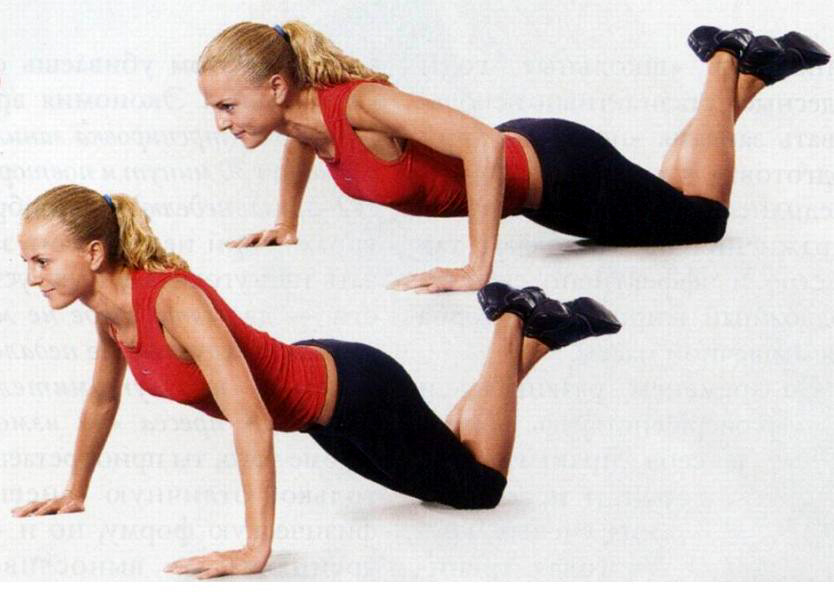
Pushups on knees (for the 2 methods below: shoulders over hands, back straight, abs contracted!)


Full pushups


(strength: works shoulders, chest, abdominals, back, and legs)


#5 --- Jumping jacks


(cardio: works quads, outer thighs, inner thighs, shoulders, abdominals, and back)


Be sure to do what is right for YOU. Use your discretion. If you have bad knees, maybe no jumping jacks, or just squat instead of doing jumping squats.

Do 1-3 sets of 8-15 repetitions. Feel free to repeat this quick and simple circuit however many times you would like! I would say repeat 4-6 times. But if you only have time for 1 circuit, then that's one more for that day!

Feel free to contact me for more information or if you have any questions. I do in home personal training, but I can also come to your work!

Now stand up and get moving!


Monday, February 10, 2014

Exercise Myths: Spot Training

In the world of fitness and exercise, there are several assumptions, lies, and myths that constantly circulate in our society. One of these that I would like to spotlight is the concept known as "spot training" or "spot reduction". Spot training is the idea that if a person performs several sets and reps on one specific area of the body (i.e. abdominals, biceps, or triceps), then they will not only tone that area more and lose fat in that specific area, but that it also won't affect other parts of the body. And unfortunately, this is absolutely not true. 

The way the body loses weight is through total body high intensity cardiovascular movement, such as running, swimming, biking, circuits, kickboxing, etc. Anything that gets that heart pumping and those lungs working. Strength training does help increase the metabolism, which in turns helps burn more calories. However, this doesn't mean that strength training a specific muscle group will help burn fat in just that area. 

Another thing to keep in mind is that everyone is different. Genetics plays a huge role in this. Everyone stores weight and loses weight in different areas of their bodies (legs, chest, arms, abdomen). Everyone's bodies burn calories at different rates (quick weight loss vs. long, slow weight loss). It is SO key for people to understand this concept. Especially my clients. This isn't negative or positive (well if you look at it negatively, then that's your prerogative). It just is what it is, and that's okay. It also means that you have to be intentional in your life.

Losing weight is very hard work. But more than that, making a healthy lifestyle change that involves healthy habits, such as daily exercise, a healthy diet using moderation, good sleep, low stress, and some indulgence now and then is even harder.....and more REWARDING!

Well, enough of my soapbox...and back to spot training. :)

According to ACSM, working to lose or maintain weight is an eventual circumstance. It is an on going, lifestyle change. For more information on spot training and other myths, check out these articles:


For questions, comments, or concerns, I would love to hear from you!


Monday, January 20, 2014

Diastasis Recti : Separation of the Abdominal Muscles

I'm back!

My apologies for being gone for so long. With the holidays, moving into a new home, and business booming more than ever, I have finally found some time to sit and write.

Today I wanted to talk a bit about what many pregnant women and new mommies are experiencing with their abdominal wall. During pregnancy, the abdominals begin to separate to allow for expansion of the ribcage and for fetal growth. This creates a small gap in the middle of the abdomen, creating a "line". This is called diastasis recti. There are many things that cause this to occur, such as a weak abdominal wall, pregnancy, hormonal surges, and studies have shown higher numbers of women having it who also had c-sections (another great reason to go natural ladies! :). Studies have also shown that 1 in 3 women get it from one or all of those causes!


Women develop this during pregnancy, and unfortunately it tends to stick around after the baby is born. So how can it be fixed? What things can be done to help strengthen the abdominal wall and lessen the diastasis recti? First, you need to see how big the separation is. Lying on your back with feet flat on the floor, lift up your head, not shoulders, bringing chin to chest. Now with your fingers pointing towards your feet, feel above your belly button for a dip. Try to see how many fingers you can fit in that separation. 


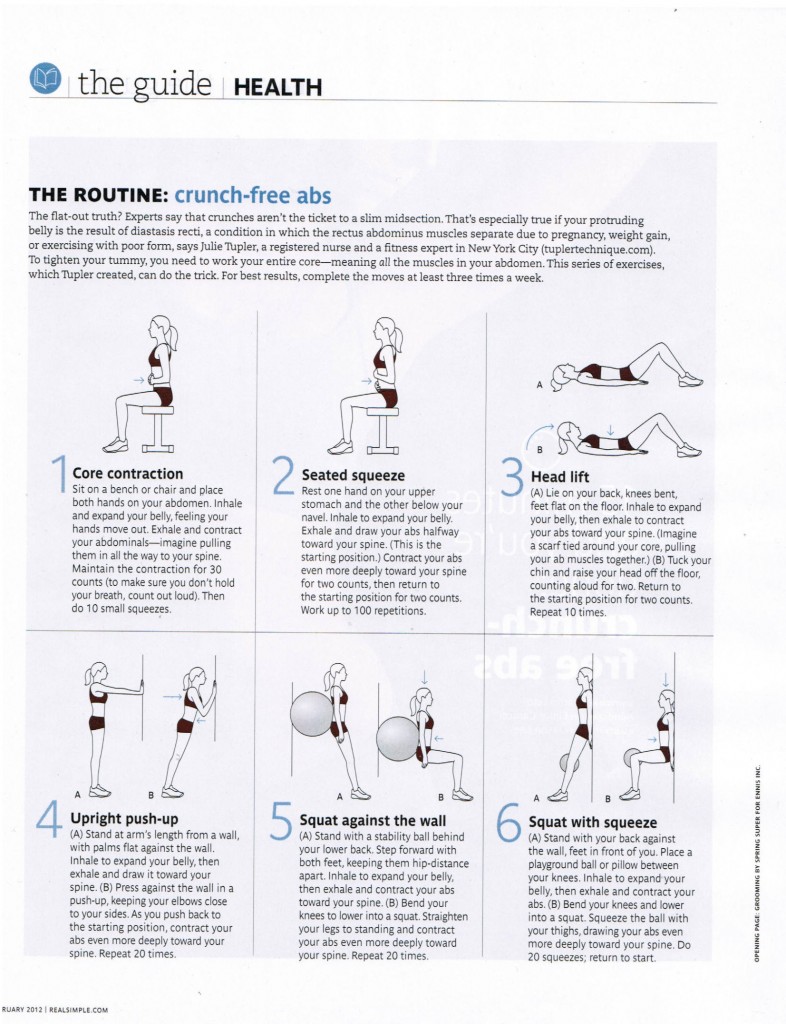
If you can fit 2 or more fingers, then do not do any crunches or sit ups of any kind, as those exercises make the separation worse. Instead, I found some crunch-free abdominal exercises that are low impact, very effective, and safe on your diastasis recti tummy. Try them out:


Doing these exercises 2-3 times per week will definitely help lessen the gap between the abdominal muscles, and also help strengthen the abdominal wall in general. This in turn will help lessen most back pain, increase posture, and decrease any risk for herniation in the abdominals. Once the separation becomes less than two fingers wides (as you should be checking your diastasis recti on a weekly basis), feel free to begin more core exercises such as these:

Plank 


Bridge 
(being sure to pull the abdominals in as you lift and lower)


Alternating Arm and Leg Lift
(keeping back straight with abs tight)


Sidelying Clam
(pulling abs in as you lift and lower leg)


Wall Squat with Ball


As the separation gets even less after doing these exercises, feel free to go back to your regular abdominal workout (crunches, bicycle crunches, full plank, push ups, etc).

Questions? Comments? Concerns?
Feel free to contact me at any time!

If you are in the Nashville area, I would love to work with you on your prenatal, postpartum, or general fitness needs and goals.

Thanks for checking in!